
TAAT e-catalog
for
Development partners
https://taat.africa/org/technologies/riceadvice-digital-support
Your Digital Guide to Better Harvests
RiceAdvice is an interactive decision support tool that generates guidelines based on farmers' responses to multiple choice questions about farm conditions, soil management, nutrient inputs, and more. It takes about 10 minutes to complete and can be done by extension agents or farmers themselves. The app identifies optimal types, amounts, and application times for inorganic fertilizers, helping farmers maximize their investments. It also provides agronomic modules to set yield objectives within budget constraints and recommends efficient weed control strategies.

This technology is TAAT1 validated.
| Project | Countries | Beneficiaries | Budget (USD) & duration | Key figures |
|---|---|---|---|---|
|
2PAU Emergency Food Production Programme |
|
|
161.96 million 2022–2023 |
|
|
ENSURE Enabling Environments for Sustainable Regional Agriculture Extension |
|
|
13.14 million 2024–2027 |
|
|
PUPSAN Emergency Production and Food & Nutrition Security Project |
|
|
7.04 million 2023–2026 |
|
Figures in italic are from project plans and may change during implementation.
Adults 18 and over: Positive low
The poor: Positive low
Under 18: Positive high
Women: Positive low
Climate adaptability: Highly adaptable
Farmer climate change readiness: Significant improvement
RiceAdvice is an Android-based decision-support tool that generates personalized agronomic recommendations based on farmers' production conditions. It improves fertilizer management, weed control, and overall farm productivity while supporting more efficient use of agricultural inputs across irrigated, rainfed lowland, and upland rice systems. The technology is well suited for climate-smart agriculture, digital extension, and rice intensification programmes, contributing to SDGs 1 (No Poverty), 2 (Zero Hunger), 8 (Decent Work and Economic Growth), 12 (Responsible Consumption and Production), and 13 (Climate Action). It strengthens digital extension services by bridging the gap in access to personalized agronomic advice for women and smallholder farmers while creating entrepreneurship opportunities for youth digital service providers. To successfully integrate this technology, consider the following key actions :
Average grain yield
Open source / open access
Scaling Readiness describes how complete a technology\’s development is and its ability to be scaled. It produces a score that measures a technology\’s readiness along two axes: the level of maturity of the idea itself, and the level to which the technology has been used so far.
Each axis goes from 0 to 9 where 9 is the “ready-to-scale” status. For each technology profile in the e-catalogs we have documented the scaling readiness status from evidence given by the technology providers. The e-catalogs only showcase technologies for which the scaling readiness score is at least 8 for maturity of the idea and 7 for the level of use.
The graph below represents visually the scaling readiness status for this technology, you can see the label of each level by hovering your mouse cursor on the number.
Read more about scaling readiness ›
Uncontrolled environment: tested
Used by some intended users, in the real world
| Maturity of the idea | Level of use | |||||||||
| 9 | ||||||||||
| 8 | ||||||||||
| 7 | ||||||||||
| 6 | ||||||||||
| 5 | ||||||||||
| 4 | ||||||||||
| 3 | ||||||||||
| 2 | ||||||||||
| 1 | ||||||||||
| 1 | 2 | 3 | 4 | 5 | 6 | 7 | 8 | 9 | ||
| Project | Countries | Beneficiaries | Budget (USD) & duration | Key figures |
|---|---|---|---|---|
|
2PAU Emergency Food Production Programme |
|
|
161.96 million 2022–2023 |
|
|
ENSURE Enabling Environments for Sustainable Regional Agriculture Extension |
|
|
13.14 million 2024–2027 |
|
|
PUPSAN Emergency Production and Food & Nutrition Security Project |
|
|
7.04 million 2023–2026 |
|
Figures in italic are from project plans and may change during implementation.
| Country | Testing ongoing | Tested | Adopted |
|---|---|---|---|
| Benin | –No ongoing testing | Tested | Adopted |
| Burkina Faso | –No ongoing testing | Tested | Adopted |
| Côte d’Ivoire | –No ongoing testing | Tested | Adopted |
| Ghana | –No ongoing testing | Tested | Adopted |
| Mali | –No ongoing testing | Tested | Adopted |
| Nigeria | –No ongoing testing | Tested | Adopted |
| Senegal | –No ongoing testing | Tested | Adopted |
| Togo | –No ongoing testing | Tested | Adopted |
This technology can be used in the colored agro-ecological zones. Any zones shown in white are not suitable for this technology.
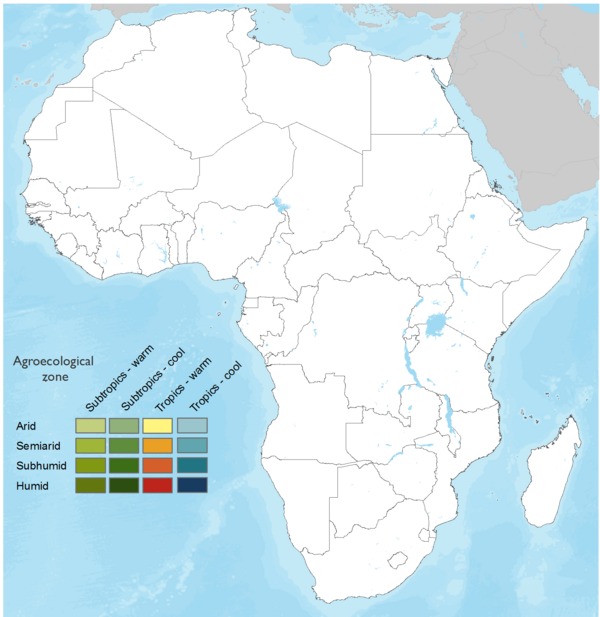




| AEZ | Subtropic - warm | Subtropic - cool | Tropic - warm | Tropic - cool |
|---|---|---|---|---|
| Arid | – | – | – | – |
| Semiarid | – | – | – | – |
| Subhumid | – | – | ||
| Humid | – | – |
Source: HarvestChoice/IFPRI 2009
The United Nations Sustainable Development Goals that are applicable to this technology.




Access the Application: Download and install the RiceAdvice app from the Google Play Store on your Android smartphone or tablet.
Complete the Questionnaire: Provide information about your farm conditions, practices, planting schedule, available equipment, prevalent weed types, fertilizer availability, and market prices.
Enter Budget and Yield Targets: Input the budget you have for investments and select your desired production level. This helps set yield targets.
Receive Personalized Recommendations: The app will generate tailored recommendations on rice variety, fertilizer plan, and agronomic practices based on the information provided.
Review and Select Preferences: Browse through the recommendations and select the options that best suit your specific circumstances and goals.
Implementation and Monitoring: Apply the recommended practices in your rice cultivation. Monitor the progress and adjust as needed.
Last updated on Jul 3, 2026
This technology can be used in the colored agro-ecological zones.






RiceAdvice digital support
https://taat.africa/org/technologies/riceadvice-digital-support
Last updated on 3 July 2026, printed on Aug 25, 2026
Enquiries e-catalogs@taat.africa